This name is consist with the rest of the setter and getter methods
in ParserOutput.  Renamed the methods in OutputPage, ImageHistoryList,
ImageHistoryPseudoPager, and ContribsPager as well for consistency;
it also makes chasing down lingering references in codesearch easier.

Soft-deprecated the old name for 1.38.  Hard-deprecation will follow,
but there are a number of users in production that should be chased
down first.

Code search:

https://codesearch.https://codesearch.wmcloud.org/deployed/?q=(allow%7Cprevent)Clickjacking&i=nope&files=&excludeFiles=&repos=

Bug: T287216
Change-Id: I9822c60c180d204bd30cb4447a1120155d456da4
The distinction between the two was lost several years years ago
when the "position top" queue ceased to be a thing. Since then,
the two have been loaded and executed together in the same batch,
and are doing similar things.

mediawiki.page.ready is publicly used in several places
as dependendency, but mediawiki.page.startup is entirely internal
to core, which makes it the easier one of the two to dissolve.

Keep an alias for two weeks for cache compat to avoid console
warnings about unknown modules. Although even some cache still
refers to it, this is harmless since the errors are recoverable
and the correct module was also loaded by the cached pages
already.

Bug: T260210
Change-Id: Ic418c23a7400abba22fd07b17f173d3c5f1d1d10
Follows-up ba50b32556, (introduce standalone "plain" mode),
and 0f9e4ca0fb (remove the skinned mode).

While both the HTML and JS payloads are already standalone, they did
internally use a fake ResourceLoaderContext object that had
the "real" skin and user language set (e.g. from the currently
logged-in user and/or site defaults).

This basically only affects 'skinStyles' and 'messages', neither
of which should be used by tests in any meaningful way.

Bug: T250045
Change-Id: Ib31934cd6dfdc5e37bccecf918f94a74e28a04b4
== What

This feature is disabled initially because we want to be able to
test it. When mw.loader's own tests are testing mw.loader.store,
they are mocking setTimeout and mw.requestIdleCallback, so that
they can then make mw.loader.store schedule its "flush" callback
and via the mock timer control when it executes and then assert
its result.

== The Bad

Previously an inline JS hack was concatenated right after startup.js,
and that seems like it should be early enough to prevent anything
from initialising mw.loader.store and scheduling a real 2s flush timer.

There is no obvious sign here that the startup module response would
request or implement a module (which could inititialise mw.loader.store).
However, there is.

== …, the Ugly

The startup response contains RLQ processing (which is empty in
the standalone test runner, so no worries here) and a call to
mw.loader.load for RLPAGEMODULES. The RLPAGEMODULES list is empty,
but it does still make a call to mw.loader.load(). And that
expands the empty array to include jquery+mediawiki.base and thus
makes a proper module request, which then initialises mw.loader.store
and schedules its 2s flush timeout.

This hasn't caused failing tests in CI so far, because there are
generally at least 2 seconds of unrelated tests that run first.
So by the time mw.loader's test suite comes around, it has
been disabled and the previous flush has already completed.

== … and the Good

Change I5f1067feb0a43d makes the 'mediawiki.jqueryMsg' test suite
super fast (previously took 2+ seconds, longer than any other test).

This exposes the fact that mw.loader.store was in fact not
actually properly disabled from the get go, and so tests would
be failing.

Bug: T250045
Change-Id: I38c3ad2a9a5813215dbb210bddafcc3cdd70295d
* Remove calls to setHeaders(), disallowUserJs().
  These never do anything because the 10 lines of standalone HTML
  page outputs don't consult OutputPage or Skin.

  The exception was the 404 handler for if you visited
  Special:JavaScriptTest/bogus, where there is nothing to protect,
  not to mention that the page is disabled by default and in any
  production environment anyhow.

* Inline the 404 handler logic.

* Update the outdated documentation for exportQUnit().

Bug: T250045
Change-Id: I2b9d712f439b270ae998e994113b7f3cd8601abf
The intro text visually renders the same without it. The parsed
message already has its own block (a paragraph).

This div is a left-over from when the test runner was a skinned
page, and we had some CSS to style it in a fancy way. All that
was removed many years a go in favour of the 10-line standalone
HTML testrunner we have today.

Bug: T250045
Change-Id: Iffcca90857cf8e5df09a9287ab22fad109df7b79
Much less indirection this way, making the test runner a bit easier
to reason about (maintenance-wise) and easier to debug for developers.
Minification doesn't help here anyway (quite the opposite).

This also means the legacy option to load a module synchronously
from ResourceLoader\ClientHtml can be removed. This option existed
solely to bootstrap the QUnit test runner, and can be removed in a
subsequent commit.

Bug: T250045
Change-Id: I73985048382e9cc754753ed84f04d25214c07599
For back-compat, keep 'user.tokens' as deprecated alias to 'user.options'
for one release cycle (to be removed in MW 1.36).

== user.options ==

As before, 'user.options' arrives immediately on every page view,
embedded in the HTML. It has an async dependency on 'user.defaults',
which is not downloaded until there is a known demand on
'user.options'. Once that arrives, the implementation closure
of 'user.options' will execute, and the module becomes 'ready'.

== user.options "empty" ==

Before this change, UserOptionsModule used isKnownEmpty to consider the
module "empty" for logged-out users (as well as for logged-in users that
haven't yet set any preferences).

This was a mistake. It is invalid in ResourceLoader to mark a module as
"empty" if that module has dependencies (see also T191596 and c3f200849).

This broke the state machine. The impact was minimal given that it is unlikely
for features to read keys from mw.user.options for logged-out users, which
if attempted would have simply returned null for all keys.

== New HTML ==

The user.options module is always embedded (never empty), and always
has a dependency on user.defaults.

== Cached HTML ==

The cached HTML for anons sets user.options's state to ready without
waiting for any dependency. Per the above, this was already causing
subtle bugs with mw.user.options.get() likely returning null for anons,
which was fairly innocent. For tokens a bottom value of null would be
problematic as the default for tokens must be "+\" instead. To make
sure that is available for cached page views, set this directly
in mediawiki.base.js. The cached HTML does contain an implement call for
'user.tokens' that contains the same defaults, but new code will not
be asking for or waiting for user.tokens, so that is unused.

Bug: T235457
Change-Id: I51e01d6fa604578cd2906337bde5a4760633c027
The test-only modules registered by QUnitTestResources.php are currently
were previously caught by the array_keys() catch-all in registerTestModules()
which meant that modules like 'test.sinonjs' would be requested on
SpecialJavaScriptTest despite not doing anything by itself, nor executing
at the "right" time per se through this means.

In order for it to execute at the right time, the testrunner has to depend
on it (which it does, already). But, that also means it doesn't need to
be requested separately. Doing so could be confusing.

This is neccecary in order to move 'jquery.qunit' from Resources.php
to QUnitTestResources.php as otherwise, listing in QUnitTestResources.php,
would implicitly mean SpecialJavaScriptTest.php thinks it's a test suite
and load it. That is a problem, because when we run the tests headless from
the command-line with Karma, the environment already has a QUnit interface
defined, and should not be loaded a second time by MW.

Change-Id: I08b31cd1dee516cf0d26bafdb8cc7c1223633bad
The ResourceLoaderModule::isRaw() feature and the ability to magically
switch a regular load.php request into raw mode is being removed soon.

Instead, specify raw=1 in the request url where that behaviour is needed.

Bug: T201483
Change-Id: Ie4564ec8e26ad53f2de1a43330d18a35b0498a63
This commit implements step 4 and step 5 of the plan outlined at T192623.

Before this task began, the typical JavaScript execution flow was:

* HTML triggers request for startup module (js req 1).
* Startup module contains registry, site config, and triggers
  a request for the base modules (js req 2).
* After the base modules arrive (which define jQuery and mw.loader),
  the startup module invokes a callback that processes RLQ,
  which is what will request modules for this page (js req 3).

In past weeks, we have:

* Made mediawiki.js independent of jQuery.
* Spun off 'mediawiki.base' from mediawiki.js – for everything
  that wasn't needed for defining `mw.loader`.
* Moved mediawiki.js from the base module request to being embedded
  as part of startup.js.

The concept of dependencies is native to ResourceLoader, and thanks to the
use of closures in mw.loader.implement() responses, we can download any
number of interdependant modules in a single request (or parallel requests).
Then, when a response arrives, mw.loader takes care to pause or resume
execution as-needed. It is normal for ResourceLoader to batch several modules
together, including their dependencies.

As such, we can eliminate one of the two roundtrips required before a
page can request modules. Specifically, we can eliminate "js req 2" (above),
by making the two remaining base modules ("jquery" and "mediawiki.base") an
implied dependency for all other modules, which ResourceLoader will naturally
fetch and execute in the right order as part of the batch request.

Bug: T192623
Change-Id: I17cd13dffebd6ae476044d8d038dc3974a1fa176
If the jQuery promise returned by mw.loader.using() is rejected
synchronously (e.g. because one of the modules has a dependency on
non-existent module), the function passed to fail() also executes
synchronously. Note that this is true also with jQuery 3.

The exception it throws was caught by the catch() below, which
resulted in start() being called twice, which resulted in QUnit
throwing 'Uncaught Error: Called start() outside of a test
context too many times' rather than actually starting.

Change-Id: I5c6b50647c0af0fdec6547aaa59165f6b4a42642
If the mw.loader.using() call's promise is rejected, we end up
passing an Error object as the 'count' parameter to QUnit.start().
This seems to be harmless, but is very confusing when debugging.

Change-Id: I44caca5285dbced5a5876d9d7ff6236dbd3efc35
ResourceLoader errors, like invalid dependencies, are
hard to spot and only result in the special page
not finding any tests.

This is not a perfect solution but it would have
saved me a full day of troubleshooting.

Change-Id: I247174f89772b84b4cad31deffb03152921df020
HTML formatting of the queue was distributed over several OutputPage methods.
Each method demanding a snippet of HTML by calling makeResourceLoaderLink()
with a limited amount of information. As such, makeResourceLoaderLink() was
unable to provide the client with the proper state information.

Centralising it also allows it to better reduce duplication in HTML output
and maintain a more accurate state.

Problems fixed by centralising:

1. The 'user' module is special (due to per-user 'version' and 'user' params).
   It is manually requested via script-src. To avoid a separate (and wrong)
   request from something that requires it, we set state=loading directly.
   However, because the module is in the bottom, the old HTML formatter could
   only put state=loading in the bottom also. This sometimes caused a wrong
   request to be fired for modules=user if something in the top queue
   triggered a requirement for it.

2. Since a464d1d4 (T87871) we track states of page-style modules, with purpose
   of allowing dependencies on style modules without risking duplicate loading
   on pages where the styles are loaded already. This didn't work, because the
   state information about page-style modules is output near the stylesheet,
   which is after the script tag with mw.loader.load(). That runs first, and
   mw.loader would still make a duplicate request before it learns the state.

Changes:

* Document reasons for style/script tag order in getHeadHtml (per 09537e83).

* Pass $type from getModuleStyles() to getAllowedModules(). This wasn't needed
  before since a duplicate check in makeResourceLoaderLink() verified the
  origin a second time.

* Declare explicit position 'top' on 'user.options' and 'user.tokens' module.
  Previously, OutputPage hardcoded them in the top. The new formatter doesn't.

* Remove getHeadScripts().
* Remove getInlineHeadScripts().
* Remove getExternalHeadScripts().
* Remove buildCssLinks().
* Remove getScriptsForBottomQueue().

* Change where Skin::setupSkinUserCss() is called. This methods lets the skin
  add modules to the queue. Previously it was called from buildCssLinks(),
  via headElement(), via prepareQuickTemplate(), via OutputPage::output().
  It's now in OutputPage::output() directly (slightly earlier). This is needed
  because prepareQuickTemplate() calls bottomScripts() before headElement().
  And bottomScript() would lazy-initialise the queue and lock it before
  setupSkinUserCss() is called from headElement().
  This makes execution order more predictable instead of being dependent on
  the arbitrary order of data extraction in prepareQuickTemplate (which varies
  from one skin to another).

* Compute isUserModulePreview() and isKnownEmpty() for the 'user' module early
  on so. This avoids wrongful loading and fixes problem 1.

Effective changes in output:

* mw.loader.state() is now before mw.loader.load(). This fixes problem 2.
* mw.loader.state() now sets 'user.options' and 'user.tokens' to "loading".
* mw.loader.state() now sets 'user' (as "loading" or "ready"). Fixes problem 1.

* The <script async src> tag for 'startup' changed position (slightly).
  Previously it was after all inline scripts and stylesheets. It's still after
  all inline scripts and after most stylesheets, but before any user styles.
  Since the queue is now formatted outside OutputPage, it can't inject the
  meta-ResourceLoaderDynamicStyles tag and user-stylesheet hack in the middle
  of existing output. This shouldn't have any noticable impact.

Bug: T87871
Change-Id: I605b8cd1e1fc009b4662a0edbc54d09dd65ee1df
Leaving behind only the so-called "plain" mode.

Also removed related unused messages (follows-up 6b758fc).

The execute() method continues to enforce 404 Not Found for arbitrary
subpage urls so that we keep the door open to add other sub resources or
test frameworks in the future.

Bug: T131389
Change-Id: I4c22666fb98e54c47ed1b4d12776af6fc43ee473
We're almost ready to drop the non-plain mode of Special:JavaScriptTest
in favour of Special:JavaScript/qunit/plain. There's a few mobile-related
extensions still using the non-karma mode for qunit testing.

However, none of them make use of the Skin selector, which was mainly a debug
thing I added in the initial version. It no longer makes sense since our tests
now enforce an anti-dependency on skin html and other context. Encouraging
testing in multiple skins in the old UI therefore no longer makes sense.

This also fixes one of the most frequent errors in resourceloader logs and gets
rid of an ugly hack in Resources.php that causes a small amount of overhead
in ResourceLoader::__construct().

> MessageBlobStore failed to find skinname-fallback
> MessageBlobStore failed to find skinname-apioutput

Change-Id: Idaacf718703883c6a7e83a17ccd3f41ebdca53d1
Page startup:
* Due to the startup module and top queue being asynchronous now,
  move client-nojs/client-js class handling to OutputPage to ensure
  there is no flashes of wrongly styled or unstyled content.

  To preserve compatibility for unsupported browsers, undo the
  class swap at runtime after the isCompatible() check.

ResourceLoader startup module:
* Load the startup module with <script async>.
* Use DOM methods instead of 'document.write' to create base module request (jquery|mediawiki).

mw.loader:
* Drop 'async' parameter from mw.loader.load().
* Remove the now-unused code paths for synchronous requests.

OutputPage:

* Drop '$loadCall' parameter from makeResourceLoaderLink().
  Asynchronous is now the default and only way to load JavaScript.
  This means the 'user' module "conditional document-write scripts"
  are now a simple "mw.loader.load( url )" call.

* Fix incorrect @return of makeResourceLoaderLink(). This returns
  an array not a string.

* Improve documentation of makeResourceLoaderLink().

* Drop '$inHead' parameter from getScriptsForBottomQueue(). No longer used.
  Compatibility with the $wgResourceLoaderExperimentalAsyncLoading
  feature is maintained. It just no longer needs to change the
  way the queue works since it's always asynchronous. The feature
  flag now only controls whether the bottom queue starts at the bottom
  or starts at the top.

* Remove jQuery.ready() optimisation.
  This was mostly there to avoid the setTimeout() loop jQuery does to detect
  dom-ready in IE6/IE7 (which we no longer serve JavaScript at all).
  And for a bug in Firefox with document.write (which is no longer used as of
  this commit).

Bug: T107399
Change-Id: Icba6d7a87b239bf127a221bc6bc432cfa71a4a72
To make unit testing easier, allow any module to be loaded within
the unit test suite. Regardless of the intended 'target'.

Targets are meant for restricting front-end scope in production.
Enforcing that in the test suite causes various test suites to
get de-registered at run time client-side.

Otherwise, in order to truly run all unit tests, Jenkins would
have to re-run the entire test suite in all known targets. This
wouldn't make sense because modules have to be globally uniquely
named (no conflicts) and unit tests are atomic. They can all run
in the same suite.

To prevent modules being comitted with incompatible target
dependencies, we already have a Structure test in the PHPUnit
suite to catch those issues in the module registry.

This makes the main 'qunit' build for MobileFrontend more useful,
where currently many modules aren't being tested due to them not
being in the 'desktop' target.

Bug: T103027
Change-Id: I69f735eb56c1362189298d9859d3add576faaadb
These were never enabled or used in production and are not
compatible with the upcoming async changes (T107399). To avoid
having to maintain compatibility with this, remove it for now.

The current on-going request to operations for ESI support is unrelated
to this code.

Considered making makeResourceLoaderLink() protected as it's not
used anywhere in @wikimedia Git outside mediawiki-core. And the unit
test actually treated it as protected already. However it's called
in SpecialJavaScriptTest so leaving that as-is for now.

In Icba6d7a87b239 the signature will change again with the removal
of the $loadCall parameter, which is obsolete in an async world
due to document.write being forbidden.

Change-Id: I9f557cc794638ffd15329934865e21e1027f7cfa
Currently there's only one framework, so having an error landing page
when visiting Special:JavaScriptTest isn't helpful. DWIM and send the
user to Special:JavaScriptTest/qunit/plain if that is the only framework
that is configured.

Also add the testing help link to the "/plain" view.

Change-Id: Ifc473d080ecf6f0a9add0510480ba9dad76050e9
The patch did not improve performance. I'd like to think that the increased
control over when inline scripts are executed makes the patch worthwhile
regardless, but that is post hoc justification and possibly a bit of personal
ego. Krinkle agrees that we may use some of the ideas in this patch in the
future but he thinks we're better off not heading down this path before we
have a better sense of where we're going, and I trust his judgment.

This reverts commit e86e5f8460.

Change-Id: I151f74a41dd664b5a0aa5cfd99fcc95e2686a1e6
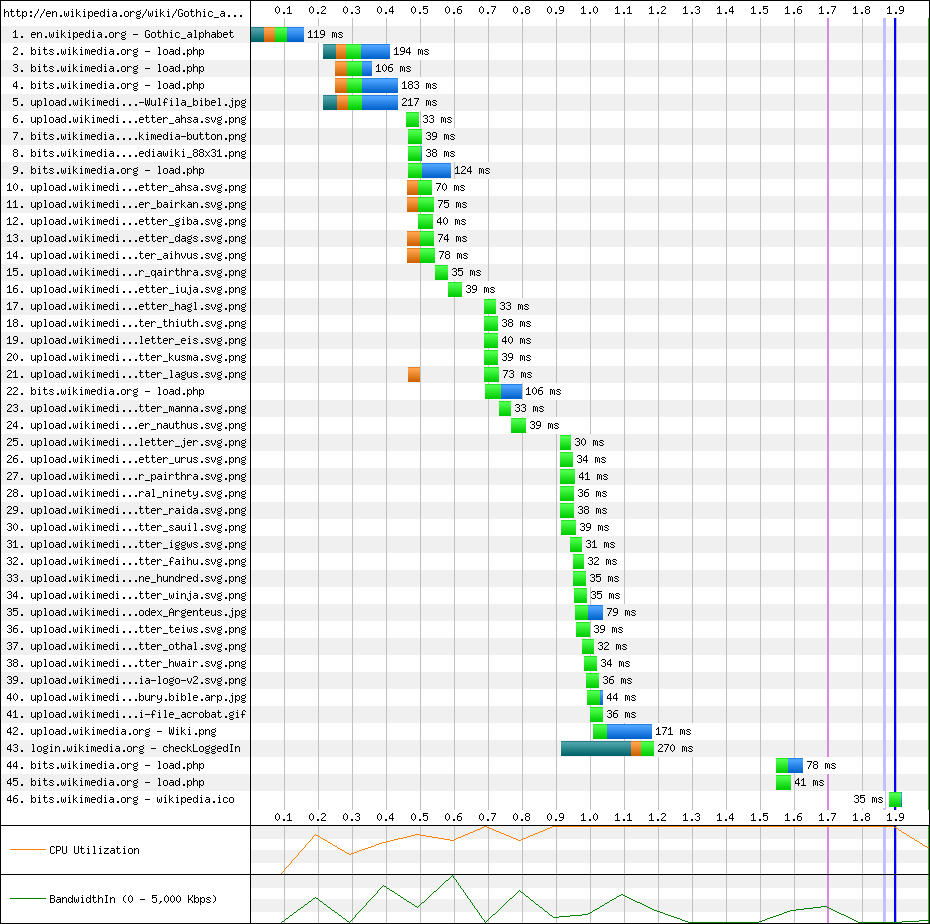
The current ordering of scripts and stylesheets in <head> causes all major
browsers to serialize and defer requests that could be performed in parallel.

The problem is that external stylesheets are loaded before inline scripts. As
Steven Souders explains, "all major browsers preserve the order of CSS and
JavaScript. The stylesheet has to be fully downloaded, parsed, and applied
before the inline script is executed. And the inline script must be executed
before the remaining resources can be downloaded. Therefore, resources that
follow a stylesheet and inline script are blocked from downloading."[1]

In other words: the browser could start loading body images, but it refuses to
do that until it has executed inline scripts in head. And it refuses to execute
those scripts until the external CSS is downloaded, parsed and applied. You can
see the effect of this in this image, showing the request waterfall for
[[en:Gothic Alphabet]]: [2]. Notice how no images were requested before the
browser had finished processing the three load.php requests at the top.

To fix this, we want to move the inline scripts above the external CSS. This is
a little bit tricky, because the inline scripts depend on mw.loader, which is
loaded via an external script. If we move the external script so that it too is
above the external stylesheet, we force the browser to serialize requests,
because the browser will not retrieve the external CSS until it has retrieved
and executed the external JS code. So what we want is to move the inline
scripts above the external stylesheet, but keep the external script (which the
inline scripts depend on) below the external stylesheet.

We can do this by wrapping the inline script code in a closure (which binds
'mw') and enqueuing the closure in a global array which will be processed by
the startup module at just the right time.

Net result: external CSS and JS is retrieved in parallel, retrieval of images
(and other external assets) is unblocked, but the order in which code is
evaluated remains the same.

[1]: <http://www.stevesouders.com/blog/2009/05/06/positioning-inline-scripts/>
[2]: <http://people.wikimedia.org/~ori/enwiki-waterfall.png> (excerpted from
 <http://www.webpagetest.org/result/150316_0C_7MB/1/details/>.

Change-Id: I98d383a6299ffbd10210431544a505338ca8643f
The inline examples in the generated documentation due to a
404 Not Found for the javascript files.

1. Run $ ./maintenance/mwjsduck-gen
2. View http://localhost/w/docs/js/#!/api/mw.Map
3. Try "Live Preview"

Change-Id: Ic44f029c789042d82ec14e35d385f9ccc59959aa
To use, ensure npm modules are up to date by running 'npm install'
in tests/frontend. Then run 'grunt qunit' to run it in Chrome.

To run it in both Firefox and Chrome (locally), run

 grunt karma:more

Moved fixture from hardcoded HTML to the testrunner so that our
tests don't depend on arbitrary HTML and thus also pass in browser
contexts where the page only loads QUnit + test suites (e.g. Karma).

Change-Id: I4e96da137340a28789b38940e75d4b6b8bc5d76a
Add an 'export' subpage to SpecialJavaScriptTest which allows
one to request a self-sufficient JavaScript payload that will
bootstrap a ResourceLoader client and load the test suites.

This is needed for using Karma (which only loads JavaScript,
no full html pages). As such elements from the Skin and OutputPage
will not exist. While all QUnit tests in MediaWiki core and
most extensions I've seen already use #qunit-fixture, this is
now required. This to prevent leakage of elements from one
test to another, but it also prevents tests from depending
on elements provided by the server.

While the Karma setup is still in the pipeline (might land before
this commit loses WIP status), for now this can be tested via
the 'Special:JavaScriptTest/qunit/plain' subpage.

Refactor:
* Use HTTP status code 404 in the response for "noframework".
* Simplify HTML footprint by using <div id="qunit"> instead of
  hardcoding the full structure. This feature was added to QUnit
  since v1.3.0 (Feb 2012), we're using v1.14.0 (Jan 2014).
  QUnit's header is automatically derived from document.title.
* Remove redundant addModules() for 'test.mediawiki.qunit.testrunner'.
  This is already added by default.
* Move allowClickjacking() call so that it applies to other modes
  as well. The exported javascript needs to have wgBreakFrame set
  to false so that test runners can frame it.
* Change mediawiki.special.javaScriptTest to not depend on QUnit.
  It caused QUnit to load on error pages. And in theory the page
  is suited for other frameworks and shouldn't load QUnit this way.

Bug: T74063
Change-Id: I3d4d0df43bb426d9579eb0349b8b5477281a7cfc
The config variable itself and the documentation property were added
in MediaWiki 1.19 (r107919 / c447423593).

The testswarm-injectjs propert was added in MediaWiki 1.20 (5e590be3d6).

We never actually ended up using TestSwarm, and this variable
is not used anywhere I can see.

Having a configuration variable for a documentation page seems
odd. I can't find another instance of this. As it's tied to development
(not for users of the wiki), link to mediawiki.org direcly.

Change-Id: Ib16607683a293b6d6661ed0411dad9a3ff551a08
- Swap "$variable type" to "type $variable"
- Added missing types
- Fixed spacing inside docs
- Makes beginning of @param/@return/@var/@throws in capital
- Changed some types to match the more common spelling

Change-Id: Ie419638e909a47aa72a274043604247830ee1a81
These modules should only be loaded when $wgEnableJavaScriptTest
is true. Move these modules to the registry that is only activated
in that context and rename the modules to be namespaced under 'test.'
so that there is no mistake when referencing these that they are
not regularly available.

Change-Id: I21e69f50b006904b12fe9f79c196c903ebff4661
Callers should use SpecialPage::getPageTitle, which is
exactly identical.

This is so that in the future we can turn SpecialPage
into a ContextSource, which requires getTitle to return
getContext()->getTitle.

Change-Id: Icdcf5d5295ef5e7f08b1d403e0c123f78738fd40
* Follows-up b2e2b2e016.
* Minor clean up of surrounding documentation comments.
* Fixed missing keys for messages in WebInstallerPage

Change-Id: Iaa692064262f3c0e10cfa5e4b1ec8c86e5d02362