These were never enabled or used in production and are not
compatible with the upcoming async changes (T107399). To avoid
having to maintain compatibility with this, remove it for now.

The current on-going request to operations for ESI support is unrelated
to this code.

Considered making makeResourceLoaderLink() protected as it's not
used anywhere in @wikimedia Git outside mediawiki-core. And the unit
test actually treated it as protected already. However it's called
in SpecialJavaScriptTest so leaving that as-is for now.

In Icba6d7a87b239 the signature will change again with the removal
of the $loadCall parameter, which is obsolete in an async world
due to document.write being forbidden.

Change-Id: I9f557cc794638ffd15329934865e21e1027f7cfa
Currently there's only one framework, so having an error landing page
when visiting Special:JavaScriptTest isn't helpful. DWIM and send the
user to Special:JavaScriptTest/qunit/plain if that is the only framework
that is configured.

Also add the testing help link to the "/plain" view.

Change-Id: Ifc473d080ecf6f0a9add0510480ba9dad76050e9
The patch did not improve performance. I'd like to think that the increased
control over when inline scripts are executed makes the patch worthwhile
regardless, but that is post hoc justification and possibly a bit of personal
ego. Krinkle agrees that we may use some of the ideas in this patch in the
future but he thinks we're better off not heading down this path before we
have a better sense of where we're going, and I trust his judgment.

This reverts commit e86e5f8460.

Change-Id: I151f74a41dd664b5a0aa5cfd99fcc95e2686a1e6
The current ordering of scripts and stylesheets in <head> causes all major
browsers to serialize and defer requests that could be performed in parallel.

The problem is that external stylesheets are loaded before inline scripts. As
Steven Souders explains, "all major browsers preserve the order of CSS and
JavaScript. The stylesheet has to be fully downloaded, parsed, and applied
before the inline script is executed. And the inline script must be executed
before the remaining resources can be downloaded. Therefore, resources that
follow a stylesheet and inline script are blocked from downloading."[1]

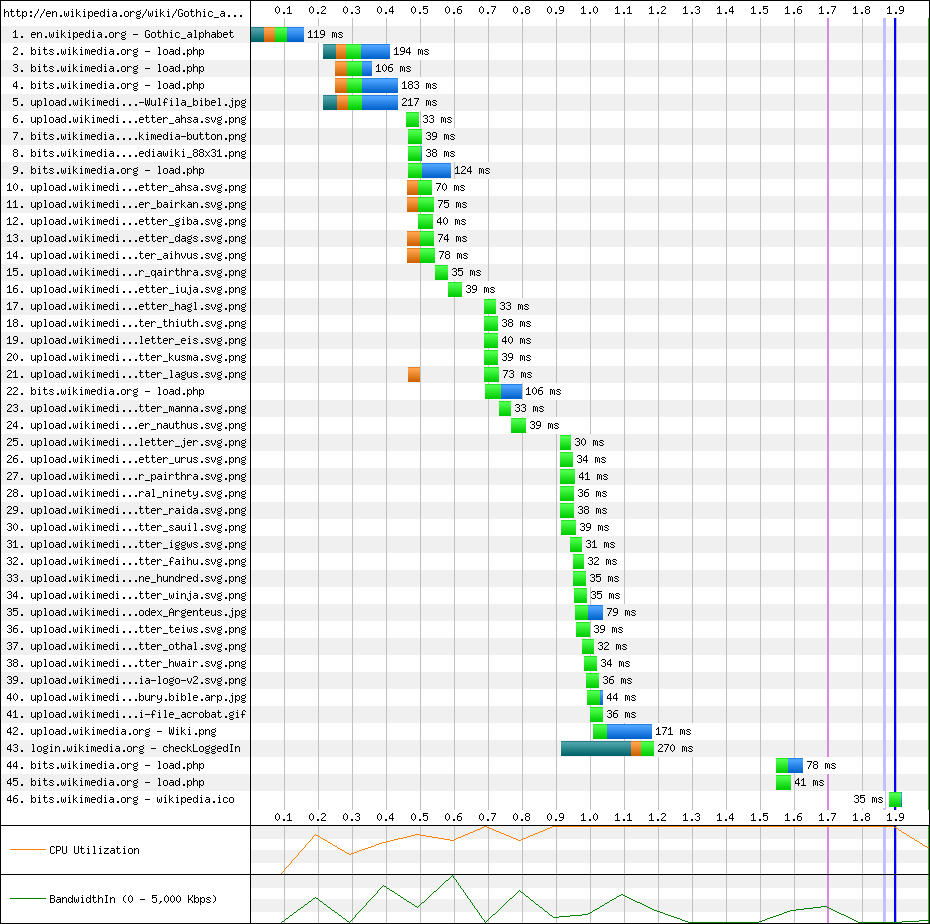
In other words: the browser could start loading body images, but it refuses to
do that until it has executed inline scripts in head. And it refuses to execute
those scripts until the external CSS is downloaded, parsed and applied. You can
see the effect of this in this image, showing the request waterfall for
[[en:Gothic Alphabet]]: [2]. Notice how no images were requested before the
browser had finished processing the three load.php requests at the top.

To fix this, we want to move the inline scripts above the external CSS. This is
a little bit tricky, because the inline scripts depend on mw.loader, which is
loaded via an external script. If we move the external script so that it too is
above the external stylesheet, we force the browser to serialize requests,
because the browser will not retrieve the external CSS until it has retrieved
and executed the external JS code. So what we want is to move the inline
scripts above the external stylesheet, but keep the external script (which the
inline scripts depend on) below the external stylesheet.

We can do this by wrapping the inline script code in a closure (which binds
'mw') and enqueuing the closure in a global array which will be processed by
the startup module at just the right time.

Net result: external CSS and JS is retrieved in parallel, retrieval of images
(and other external assets) is unblocked, but the order in which code is
evaluated remains the same.

[1]: <http://www.stevesouders.com/blog/2009/05/06/positioning-inline-scripts/>
[2]: <http://people.wikimedia.org/~ori/enwiki-waterfall.png> (excerpted from
 <http://www.webpagetest.org/result/150316_0C_7MB/1/details/>.

Change-Id: I98d383a6299ffbd10210431544a505338ca8643f
The inline examples in the generated documentation due to a
404 Not Found for the javascript files.

1. Run $ ./maintenance/mwjsduck-gen
2. View http://localhost/w/docs/js/#!/api/mw.Map
3. Try "Live Preview"

Change-Id: Ic44f029c789042d82ec14e35d385f9ccc59959aa
To use, ensure npm modules are up to date by running 'npm install'
in tests/frontend. Then run 'grunt qunit' to run it in Chrome.

To run it in both Firefox and Chrome (locally), run

 grunt karma:more

Moved fixture from hardcoded HTML to the testrunner so that our
tests don't depend on arbitrary HTML and thus also pass in browser
contexts where the page only loads QUnit + test suites (e.g. Karma).

Change-Id: I4e96da137340a28789b38940e75d4b6b8bc5d76a
Add an 'export' subpage to SpecialJavaScriptTest which allows
one to request a self-sufficient JavaScript payload that will
bootstrap a ResourceLoader client and load the test suites.

This is needed for using Karma (which only loads JavaScript,
no full html pages). As such elements from the Skin and OutputPage
will not exist. While all QUnit tests in MediaWiki core and
most extensions I've seen already use #qunit-fixture, this is
now required. This to prevent leakage of elements from one
test to another, but it also prevents tests from depending
on elements provided by the server.

While the Karma setup is still in the pipeline (might land before
this commit loses WIP status), for now this can be tested via
the 'Special:JavaScriptTest/qunit/plain' subpage.

Refactor:
* Use HTTP status code 404 in the response for "noframework".
* Simplify HTML footprint by using <div id="qunit"> instead of
  hardcoding the full structure. This feature was added to QUnit
  since v1.3.0 (Feb 2012), we're using v1.14.0 (Jan 2014).
  QUnit's header is automatically derived from document.title.
* Remove redundant addModules() for 'test.mediawiki.qunit.testrunner'.
  This is already added by default.
* Move allowClickjacking() call so that it applies to other modes
  as well. The exported javascript needs to have wgBreakFrame set
  to false so that test runners can frame it.
* Change mediawiki.special.javaScriptTest to not depend on QUnit.
  It caused QUnit to load on error pages. And in theory the page
  is suited for other frameworks and shouldn't load QUnit this way.

Bug: T74063
Change-Id: I3d4d0df43bb426d9579eb0349b8b5477281a7cfc
The config variable itself and the documentation property were added
in MediaWiki 1.19 (r107919 / c447423593).

The testswarm-injectjs propert was added in MediaWiki 1.20 (5e590be3d6).

We never actually ended up using TestSwarm, and this variable
is not used anywhere I can see.

Having a configuration variable for a documentation page seems
odd. I can't find another instance of this. As it's tied to development
(not for users of the wiki), link to mediawiki.org direcly.

Change-Id: Ib16607683a293b6d6661ed0411dad9a3ff551a08
- Swap "$variable type" to "type $variable"
- Added missing types
- Fixed spacing inside docs
- Makes beginning of @param/@return/@var/@throws in capital
- Changed some types to match the more common spelling

Change-Id: Ie419638e909a47aa72a274043604247830ee1a81
These modules should only be loaded when $wgEnableJavaScriptTest
is true. Move these modules to the registry that is only activated
in that context and rename the modules to be namespaced under 'test.'
so that there is no mistake when referencing these that they are
not regularly available.

Change-Id: I21e69f50b006904b12fe9f79c196c903ebff4661
Callers should use SpecialPage::getPageTitle, which is
exactly identical.

This is so that in the future we can turn SpecialPage
into a ContextSource, which requires getTitle to return
getContext()->getTitle.

Change-Id: Icdcf5d5295ef5e7f08b1d403e0c123f78738fd40
* Follows-up b2e2b2e016.
* Minor clean up of surrounding documentation comments.
* Fixed missing keys for messages in WebInstallerPage

Change-Id: Iaa692064262f3c0e10cfa5e4b1ec8c86e5d02362
* Removed spaces around array index
* Removed double spaces or added spaces to begin or end of function
  calls, method signature, conditions or foreachs
* Added braces to one-line ifs
* Changed multi line conditions to one line conditions
* Realigned some arrays

Change-Id: Ia04d2a99d663b07101013c2d53b3b2e872fd9cc3
Doxygen expects parameter types to come before the
parameter name in @param tags. Used a quick regex
to switch everything around where possible. This
only fixes cases where a primitve variable (or a
primitive followed by other types) is the variable
type. Other cases will need to be fixed manually.

Change-Id: Ic59fd20856eb0489d70f3469a56ebce0efb3db13
Having all group mapping for Special:SpecialPages in the global
$wgSpecialPageGroups is not a good OO style.
Created a method SpecialPage::getGroupName, which than can be overridden
by each subclasses to the featured group name.

Added also SpecialPage::getFinalGroupName to get the groupname on
Special:SpecialPages to handle the customization and
to keep $wgSpecialPageGroups for b/c

Change-Id: I1de3a186f0a59ec5ecb8996c5f805cf164e9637f
It is better when the special page is not register,
instead of giving a hint, that this is disabled on the wiki.

See other special pages like Special:PopularPages or Special:ChangeEmail

Change-Id: I43fb118d61ddcb2536192f54ee888d55b2fbd49d
So far we've still been using ./tests/qunit/index.html in TestSwarm, today I've tested locally
to submit a url to SpecialJavaScriptTest instead and made a bunch of browsers join my swarm,
quite a few problems popped up. This commit fixes those issues so that we can actually use
SpecialJavaScriptTest in TestSwarm.

* Add QUnit configuration variable for TestSwarm's inject.js

  In order to use TestSwarm, the urls that TestSwarm loads in clients that has
  the QUnit test suite running on it need to include a little javascript.
  This inject.js registers hooks with QUnit to listen for when the test suite finishes
  and contacts the parent window (TestSwarm loads the qunit test suite url in an iframe)
  to submit the results. Previously I included a copy of TestSwarm's inject.js in
  ./tests/qunit/data and in our testrunner.js a relative link to that.
  However this is currently breaking because it is an outdated version. Updating brings
  no good since someone else might use their own TestSwarm would could still run on an old
  version etc. The TestSwarm submitted too always expects that it's own inject.js is used,
  not some snapshot copy. I've removed the copy of it in MediaWiki and instead added a
  configuration option to point to wherever the you want is located.

  Also, since the old static index.html version of the unit test can't retrieve PHP based
  content, this means TestSwarm submissions through the old static index.html are no longer
  supported. Only through the new Special:JavaScriptTest from now on. I'll probably remove
  the whole index.html soon-ish as it's getting quite annoying to maintain all that by hand,
  and it's been superseded in everywhere imaginable now anyway. Even not used anymore by
  intergration.mediawiki.org because that's been quiet since the Git-switchover.., and when
  we update it, we can update it to point to the new SpecialPage instead.

* OutputPage::allowClickjacking() on SpecialJavaScriptTest/qunit.

  When initially testing the TestSwarm setup to submit SpecialJavaScriptTest/qunit urls
  (instead of the old ./tests/qunit/index.html) it was failing due to an iframe DENY.
  This was a bit odd since `$wgBreakFrames = false;` by default, and although
  `$wgEditPageFrameOptions = 'DENY';` by default, it wasn't obvious at all that that value
  ("DENY") is used for all OutputPages by default (as supposed to just action=edit and the
  like). This is because OutputPage has  mPreventClickjacking=true by default and when it's
  true-ish it uses $wgEditPageFrameOptions for the X-Frame-Options.

* 'position' => true; for the mediawiki.tests.qunit.suites module.

  QUnit has a hook for "done". Which is called when QUnit.start() is called and all queued tests
  have been executed. QUnit.start() is automatically called on window.onload by QUnit.

  TestSwarm uses QUnit's hook system to hook into the QUnit "done" event, and at that point
  takes the stats, submits them to TestSwarm and go on with the next job.

  When testing locally, I got semi-random failures reporting that only 0/0 tests were
  successfully ran in IE6. This is because when QUnit.start (and consequently QUnit.done)
  are first called, apparently no test suites had finished downloading and/or execution yet
  (the bottom queue is asynchronous, and doesn't postpone domready nor window.onload).

  When normally viewing Special:JavaScriptTest/qunit this doesn't break anything, because if
  QUnit start/done is in the past and another module(), test(), or equal() etc. is called it just
  picks up again and adds more results to the page and calls QUnit.done() again.
  However in the case of the TestSwarm embed, it submits the results after the first done() and
  cleans up the iframe. So I'm making mediawiki.tests.qunit.suites a blocking module instead, so
  that there will only be one QUnit.start/done and that's the one that TestSwarm gets and after
  which TestSwarm can safely garbage the iframe.

  This means that basically all test suite modules and the original modules they are testing will
  be loaded from the head. Shouldn't have any side effects, but might cause minor breakage in
  future in modules that badly assume they're being put on the bottom.
  I'm not considering that a bug in the test, it'll just help catch that bad code sooner :),
  it's a test suite after all.

(Yay, my first Git commit to MediaWiki core)

Change-Id: I83f83377f2183b6deb4e901af602ac9a5628558b
* Through all QUnit updates, the html was never updated (only the JS/CSS files). Updating html now according to QUnit documentation. (introduced a new html element used for adding test document elements which are automatically cleaned up. the JS/CSS for QUnit was already referring to this but silently failing)
* wrapSummaryHTML() now really need one of three states or an exception
  is thrown.
* Moved a parameter incorrectly passed to addHtml() up to the previous
  wrapSummaryHtml() code. Per CR on r107919
Changed written by Timo and reviewed by Hashar. This should be harmless.

To enable the feature:
  $wgEnableJavaScriptTest = true;

Then head to:
  [[Special:JavaScriptTest/qunit]]