ApiResult was a mess: some methods could only be used with an array
reference instead of manipulating the stored data, methods that had both
array-ref and internal-data versions had names that didn't at all
correspond, some methods that worked on an array reference were
annoyingly non-static, and then the whole mess with setIndexedTagName.

ApiFormatXml is also entirely annoying to deal with, as it liked to
throw exceptions if certain metadata wasn't provided that no other
formatter required. Its legacy also means we have this silly convention
of using empty-string rather than boolean true, annoying restrictions on
keys (leading to things that should be hashes being arrays of key-value
object instead), '*' used as a key all over the place, and so on.

So, changes here:
* ApiResult is no longer an ApiBase or a ContextSource.
* Wherever sensible, ApiResult provides a static method working on an
  arrayref and a non-static method working on internal data.
* Metadata is now always added to ApiResult's internal data structure.
  Formatters are responsible for stripping it if necessary. "raw mode"
  is deprecated.
* New metadata to replace the '*' key, solve the array() => '[]' vs '{}'
  question, and so on.
* New class for formatting warnings and errors using i18n messages, and
  support for multiple errors and a more machine-readable format for
  warnings. For the moment, though, the actual output will not be changing
  yet (see T47843 for future plans).
* New formatversion parameter for format=json and format=php, to select
  between BC mode and the modern output.
* In BC mode, booleans will be converted to empty-string presence style;
  modules currently returning booleans will need to use
  ApiResult::META_BC_BOOLS to preserve their current output.

Actual changes to the API modules' output (e.g. actually returning
booleans for the new formatversion) beyond the use of
ApiResult::setContentValue() are left for a future change.

Bug: T76728
Bug: T57371
Bug: T33629
Change-Id: I7b37295e8862b188d1f3b0cd07f66ac34629678f
The patch did not improve performance. I'd like to think that the increased
control over when inline scripts are executed makes the patch worthwhile
regardless, but that is post hoc justification and possibly a bit of personal
ego. Krinkle agrees that we may use some of the ideas in this patch in the
future but he thinks we're better off not heading down this path before we
have a better sense of where we're going, and I trust his judgment.

This reverts commit e86e5f8460.

Change-Id: I151f74a41dd664b5a0aa5cfd99fcc95e2686a1e6
This drops support for the custom utf8 normal PHP extension in favor
of the intl extension.

Bug: T90825
Change-Id: Ifbaeb2ef684217cf6187ccc4fb4d303f89608300
The current ordering of scripts and stylesheets in <head> causes all major
browsers to serialize and defer requests that could be performed in parallel.

The problem is that external stylesheets are loaded before inline scripts. As
Steven Souders explains, "all major browsers preserve the order of CSS and
JavaScript. The stylesheet has to be fully downloaded, parsed, and applied
before the inline script is executed. And the inline script must be executed
before the remaining resources can be downloaded. Therefore, resources that
follow a stylesheet and inline script are blocked from downloading."[1]

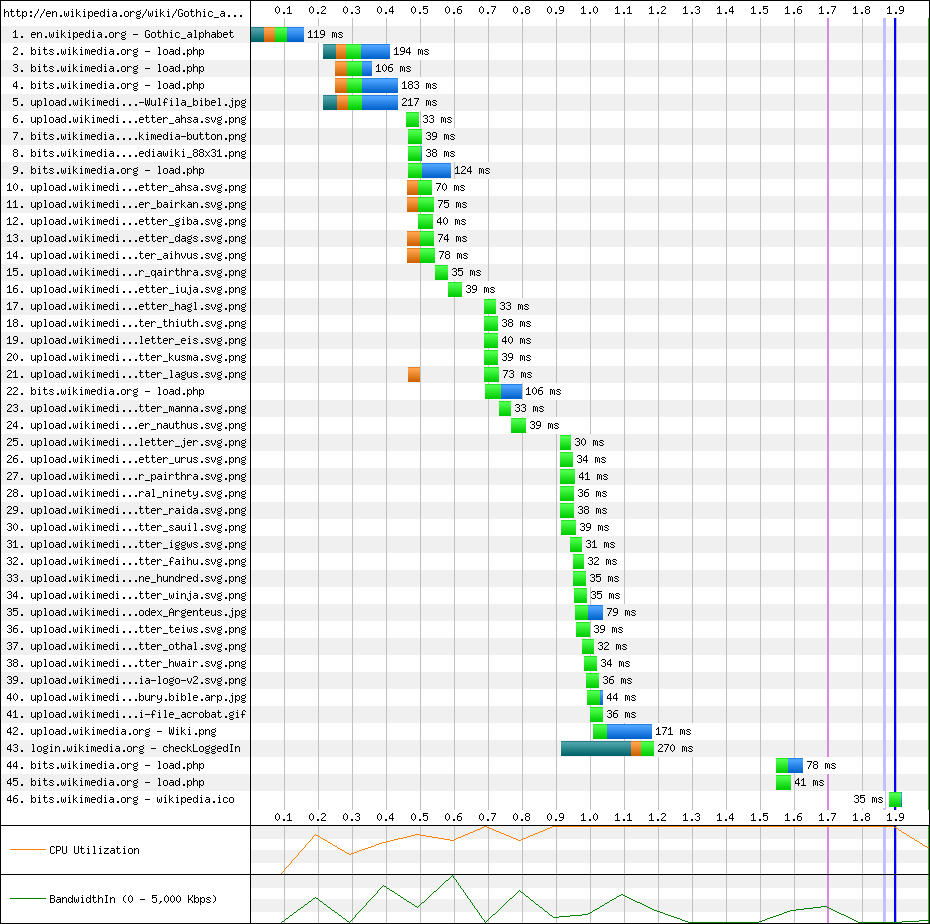
In other words: the browser could start loading body images, but it refuses to
do that until it has executed inline scripts in head. And it refuses to execute
those scripts until the external CSS is downloaded, parsed and applied. You can
see the effect of this in this image, showing the request waterfall for
[[en:Gothic Alphabet]]: [2]. Notice how no images were requested before the
browser had finished processing the three load.php requests at the top.

To fix this, we want to move the inline scripts above the external CSS. This is
a little bit tricky, because the inline scripts depend on mw.loader, which is
loaded via an external script. If we move the external script so that it too is
above the external stylesheet, we force the browser to serialize requests,
because the browser will not retrieve the external CSS until it has retrieved
and executed the external JS code. So what we want is to move the inline
scripts above the external stylesheet, but keep the external script (which the
inline scripts depend on) below the external stylesheet.

We can do this by wrapping the inline script code in a closure (which binds
'mw') and enqueuing the closure in a global array which will be processed by
the startup module at just the right time.

Net result: external CSS and JS is retrieved in parallel, retrieval of images
(and other external assets) is unblocked, but the order in which code is
evaluated remains the same.

[1]: <http://www.stevesouders.com/blog/2009/05/06/positioning-inline-scripts/>
[2]: <http://people.wikimedia.org/~ori/enwiki-waterfall.png> (excerpted from
 <http://www.webpagetest.org/result/150316_0C_7MB/1/details/>.

Change-Id: I98d383a6299ffbd10210431544a505338ca8643f
These functions actually does not return anything, so the @return is
wrong here. '@return void' is ignored.

Change-Id: I11495ee05b943c16c1c4715d617c8b50de22276c
Strings like "5.6.99-hhvm" are not version numbers but merely
a way for HHVM to pass version checks. They should not be
displayed in the UI.

This affects Special:Version, the API (action=query&meta=siteinfo),
the installer welcome page, and the debug toolbar.

Follows-up d09ab9001f.

Change-Id: Ia99dca64779e9c4eaddf5f0e0101674d029b8d55