SVGs could already be used through $wgLogo. However, if a PNG fallback
is desired for older browsers, using SVGs was previously not possible.

This commit adds support for using an SVG image in $wgLogoHD and,
using $wgLogo as the fallback image.

Usage example:

> $wgLogo = '/path/to/png';
> $wgLogoHD = [
>     'svg' => 'path/to/svg',
> ];

Note: When the 'svg' key is set in $wgLogoHD, any '1.5x' and '2x' keys will
no longer be used because SVGs can render optimally on any screen sizes.

@Reedy, @Krinkle and @Brion VIBBER helped me alot with this.

Bug: T86229
Change-Id: I6197d96ce9110f4711ef2c4b198445bc5c6ae110
This fixes two bugs:

* 1) When two modules are requested, and the first one ends with ";"
     inside a comment, the second module might become part of
     that comment.
* 2) A request with script=only where the requested module content
     ends in a statement without ";", but has a comment after it
     that does ends with a semicolon, then in debug=false, mw.loader.state()
     would be appended directly after the semicolon-less statement because
     the check is performed before minification.
     Previously:
     script> foo()
     script> // bar();
     states> mw.loader.state( {} );
     Became (minified separately):
     script> foo()
     states> mw.loader.state({});
     Became (concatenated)
     > foo()mw.loader.state();
     Which is invalid code.

Both of these are now fixed.

Bug: T162719
Change-Id: Ic8114c46ce232f5869400eaa40d3027003550533
Regardless of whether other modules exist with group=user or group=site,
these two modules in particular must always be in their own request for
legacy reasons.

This has already always been the case because even in the few cases where
an extension uses this group (eg. MobileFrontend's custom site module) it
would load it instead of another module in that group, never at the same
time. There is one notable exception, which is GlobalCssJs. However the
ext.globalCssJs.user.styles module is usually served from another wiki
which is why that went unnoticed as well. This commit fixes that so that
even if you're viewing a page on the central wiki, the modules are still
in separate requests.

Aside from this one existing edge case, there is also need to add
group=site to gadgets by default so that they load after the DynamicStyles
marker instead of before, which is currently causing problems with the
cascading order (gadget apply before core and skin styles due to being
in the same request group and alphabetically sorting before them).

Semantically, the appropiate solution is group=site, but this wasn't
possible due to core putting "all" group=site modules in the same request
(under the assumption there is only one such module). This commit removes
that fragile assumption.

Bug: T147667
Change-Id: I9eb725c083124d22a9af3bf3d075ade6f3b970a3
Replaces \TestingAccessWrapper (defined in core) with
\Wikimedia\TestingAccessWrapper (defined in the composer package
wikimedia/testing-access-wrapper).

See https://gerrit.wikimedia.org/r/#/q/topic:librarize-testing-access-wrapper
for downstream patches.

The core version of the class is kept around for a while to avoid
circular dependency problems.

Bug: T163434
Change-Id: I52cc257e593da3d6c3b01a909e554a950225aec8
Follows-up 5f55e9c9c2.

If the logo url is from within /w, then ResourceLoaderSkinModule
will (as it should) apply a file hash query to it.

The preloader didn't do that, so it specified the wrong url.

Refactored SkinModule to make this logic re-usable.

Bug: T100999
Change-Id: I1ba11f7c70d1a725ad72754fee4a3f33c2a4c1be
This greatly increases the priority of loading
the logo on browsers that support rel="preload".

Bug: T100999
Change-Id: I0738fcc0a575153dab65016fa87faaa9b8b97a9d
Updated tests to reflect this use case. Currently we assume all web-accessible
paths within ResourceBasePath (e.g "/w") to exist on disk at the same path
in $IP (e.g. "/var/www/mw").

While in theory any number of web server rewrites or aliases could exist,
there is one case in particular that we should support since the information
is available in the configuration: UploadDir and UploadPath. This path may
be rewritten in a way that varies by wiki in multi-wiki installs that share
the same source code. E.g. a server may rewrite "/w/images" to somewhere
else, which means it will not match the directory on disk that is shared
between wikis.

Bug: T155146
Change-Id: I320478c9c262cc012f08b585b48d290594ec2420
This is a very basic test setup for the core functionality only. All
the special cases in getHeadLinksArray are currently not tested. But
this is a start.

This is relevant for the changes made in Ie8fd697.

Bug: T51859
Change-Id: I61e2da68ae0daea15fab2065a5dd63605d0b837d
transformResourcePath is only supposed to be called with something
that starts with a '/' (absolute path from document root).

While the primary caller (CSSMin) only calls this method if the path
makes sense as a local file path, ResourceLoaderSkinModule did not,
and wgLogo may be set to a full url that includes a domain.

While chance made it so that protocol-including urls were already
discarded, protocol-relative urls were mistaken for being a path
inside the file system root with a duplicate slash (e.g.
'//tmp/foo.txt', as 'foo.txt' in /fmp, instead of '/foo.txt' at
http://tmp).

This should be fixed upstream in the wikimedia/relpath library,
but workaround it for now since it really shouldn't be called
with urls in the first place.

Bug: T155310
Change-Id: I9b063f1219ddeca5cc2c8a48832cdf8c9eaffe58
This is a pure documentation change. It mostly removes empty lines from
comments (and entirely empty comments), as well as adds a few missing
documentation blocks and fixes a minor mistake. I hope it's ok to have
this in one patch. I can split it, please tell me.

Change-Id: I9668338602ac77b903ab6b02ff56bd52743c37c4
There's currently no way to get, e.g., all categories except the
hidden ones just as text. The OutputPage::getCategories() method
always returns all categories as an array of strings (titles) and
the getCategoryLinks() method returns the result of Linker::link
but with the distinction between "normal" and "hidden" categories.

This change adds a new parameter to OutputPage::getCategories(),
$type, which can be used to define, what categories should be
returned. The default value is "all", which means, that all categories
are returned (the current result of the method). With the value
"normal" and "hidden", the method will return the respective values.

This could be used in I97d7de723fe72da26c7dbde0a559a13704c7099a to
remove the stupid Linker::link() and isset workaround.

Change-Id: Iadda9ae362a21fbee770240234b8f55326219932
HTML formatting of the queue was distributed over several OutputPage methods.
Each method demanding a snippet of HTML by calling makeResourceLoaderLink()
with a limited amount of information. As such, makeResourceLoaderLink() was
unable to provide the client with the proper state information.

Centralising it also allows it to better reduce duplication in HTML output
and maintain a more accurate state.

Problems fixed by centralising:

1. The 'user' module is special (due to per-user 'version' and 'user' params).
   It is manually requested via script-src. To avoid a separate (and wrong)
   request from something that requires it, we set state=loading directly.
   However, because the module is in the bottom, the old HTML formatter could
   only put state=loading in the bottom also. This sometimes caused a wrong
   request to be fired for modules=user if something in the top queue
   triggered a requirement for it.

2. Since a464d1d4 (T87871) we track states of page-style modules, with purpose
   of allowing dependencies on style modules without risking duplicate loading
   on pages where the styles are loaded already. This didn't work, because the
   state information about page-style modules is output near the stylesheet,
   which is after the script tag with mw.loader.load(). That runs first, and
   mw.loader would still make a duplicate request before it learns the state.

Changes:

* Document reasons for style/script tag order in getHeadHtml (per 09537e83).

* Pass $type from getModuleStyles() to getAllowedModules(). This wasn't needed
  before since a duplicate check in makeResourceLoaderLink() verified the
  origin a second time.

* Declare explicit position 'top' on 'user.options' and 'user.tokens' module.
  Previously, OutputPage hardcoded them in the top. The new formatter doesn't.

* Remove getHeadScripts().
* Remove getInlineHeadScripts().
* Remove getExternalHeadScripts().
* Remove buildCssLinks().
* Remove getScriptsForBottomQueue().

* Change where Skin::setupSkinUserCss() is called. This methods lets the skin
  add modules to the queue. Previously it was called from buildCssLinks(),
  via headElement(), via prepareQuickTemplate(), via OutputPage::output().
  It's now in OutputPage::output() directly (slightly earlier). This is needed
  because prepareQuickTemplate() calls bottomScripts() before headElement().
  And bottomScript() would lazy-initialise the queue and lock it before
  setupSkinUserCss() is called from headElement().
  This makes execution order more predictable instead of being dependent on
  the arbitrary order of data extraction in prepareQuickTemplate (which varies
  from one skin to another).

* Compute isUserModulePreview() and isKnownEmpty() for the 'user' module early
  on so. This avoids wrongful loading and fixes problem 1.

Effective changes in output:

* mw.loader.state() is now before mw.loader.load(). This fixes problem 2.
* mw.loader.state() now sets 'user.options' and 'user.tokens' to "loading".
* mw.loader.state() now sets 'user' (as "loading" or "ready"). Fixes problem 1.

* The <script async src> tag for 'startup' changed position (slightly).
  Previously it was after all inline scripts and stylesheets. It's still after
  all inline scripts and after most stylesheets, but before any user styles.
  Since the queue is now formatted outside OutputPage, it can't inject the
  meta-ResourceLoaderDynamicStyles tag and user-stylesheet hack in the middle
  of existing output. This shouldn't have any noticable impact.

Bug: T87871
Change-Id: I605b8cd1e1fc009b4662a0edbc54d09dd65ee1df
tl;dr: Having unnessary complexity in security critical code is bad.

* Extra options add extra complexity and maintenance burden
** Thus we should only have one html output mode. well formed = false
     was already vetoed in T52040, so lets go with WellFormed=true.
* Options which are used by very few people tend to get tested less
* Escaping is an area of code where we should be very conservative
* Having escaping rules depend on making assumptions about which
    characters various browsers consider "whitespace" is scary
* $wgWellFormedXml=false has had a negative security impact in the
    past (Usually not directly its fault, but has made other bugs
    more exploitable)
* Saving a couple bytes (even less bytes after gzip taken into
    account) is really not worth it in this context (imho).

Change-Id: I5c922e0980d3f9eb39adb5bb5833e158afda42ed
* Send 'module' and 'require' parameters to module closures.
  This depends on Ia925844cc22f143 being deployed one cycle earlier.
* Patch Moment and OOjs to ensure these libraries continue to expose
  their module as globals as well. AMD/UMD-compatible libraries
  only expose a global *OR* an export, not both. We need both
  for back-compat.
* Update pluralRuleParser to make use of module export to allow
  usage via require().

To test, check out the patch and run:
> mw.loader.load('moment');
> mw.loader.require('moment')()
> mw.loader.require('moment')('2011-04-01').fromNow()

Bug: T108655
Change-Id: Idbd054880ee70d659ec760aef8fcb38d0704a394
* Remove trailing space in self-closing tag.
  Brings parserTest output of Parser and Parsoid closer together.

* Remove various line breaks at begin and end of script contents.

* Remove FILTER_NOMIN from makeConfigSetScript() output.
  This isn't part of any user- or page-dependent module and not minified.
  And Xml::encodeJsCall already ensures compact output for prod mode.

Bug: T127328
Change-Id: I85a5a59fd0955c1a112e8b24b933f0d9e983a156
startup.js:
* Don't assign to "window.RLQ" and read from "RLQ". Use the same
  identifier in both places instead of relying on global scope.
* Create the global window.RLQ only once. The temporary [] fallback
  doesn't need to be exposed globally, so use a local variable for
  the loop that processes the pre-existing queue built up while
  the startup module was loading.

OutputPage:
* Simplify the RLQ wrap to be more idiomatic and less repetitive.
  Matches the pattern used in Google and Facebook open-source projects.

Change-Id: I9176377bc05432e51add841696a356428feec8ce
MessageBlobStore class:
* Make logger aware.
* Log an error if json encoding fails.
* Stop using the DB table. WANObjectCache supports everything we need:
  - Batch retrieval.
  - Invalidate keys with wildcard selects or cascading check keys.
* Update tests slightly since the actual update now happens on-demand as
  part of get() instead of within updateMessage().

ResourceLoader class:
* Remove all interaction with the msg_resource table. Remove db table later.
* Refactor code to use a hash of the blob instead of a timestamp.
  Timestamps are unreliable and roll over too frequently for message blob store
  because there is no authoritative source. The timestamps were inferred based on
  when a change is observed. Message overrides from the local wiki have an
  explicit update event when the page is edited. All other messages, such as
  from MediaWiki core and extensions using LocalisationCache, have a single
  timestamp for all messages which rolls over every time the cache is rebuilt.
  A hash is deterministic, and won't cause needless invalidation (T102578).
* Remove redundant pre-fetching in makeModuleResponse().
  This is already done by preloadModuleInfo() in respond().
* Don't bother storing and retreiving empty "{}" objects.
  Instead, detect whether a module's message list is empty at runtime.

ResourceLoaderModule class:
* Make logger aware.
* Log if a module's message blob was not preloaded.

cleanupRemovedModules:
* Now that blobs have a TTL, there's no need to prune old entries.

Bug: T113092
Bug: T92357
Change-Id: Id8c26f41a82597e34013f95294cdc3971a4f52ae
Ensure that OutputPage::haveVaryCacheCookies() handles falsey values correctly,
and that it requires a cookie to have a nonempty value before it declares a
match.

Change-Id: I2afe54b62c940187a427498cb4037e1dd0e78dd9
MediaWiki currently has support for a header called X-Vary-Options
(XVO), used to communicate to upstream caches more granular cache
variance options than the Vary header can.

The header was envisioned by Tim Starling back in 2008 and implemented
into MediaWiki and Squid 2.0, with those patches submitted to the
squid-dev mailing list at the time:
http://www.squid-cache.org/mail-archive/squid-dev/200802/0085.html
The patches never actually made it into an upstream Squid release,
however, and Squid has since evolved in potentially significant ways.

Wikimedia has since switched to Varnish but XVO was not ported over as
it was deemed too complex at the time; custom VCL was used instead. To
our knowledge, noone else is using XVO in production and certainly not
with recent, up-to-date MediaWiki releases.

There is currently work at IETF's httpbis working group for a "Key"
header that is in concept and implementation very similar to Tim's XVO
header: https://datatracker.ietf.org/doc/draft-fielding-http-key/

Rather than rip XVO out of MediaWiki, replace it with support for the
Key header, as preliminary defined by the draft spec. This is an almost
straight search-and-replace.

No other software (caching proxy or user-agent) currently implements Key
to my knowledge, so this is essentially untested.

Change-Id: I949fc289dd5d48bd34f3b37f7739e2b9cd5db277
Rewrite OutputPage::addVaryHeader which had a very confusing
structure.

There is one breaking change: the $option argument was declared
as array|null, but the function accepted everything and showed
inconsistent behavior; e.g.

    $op->addVaryHeader( 'Foo', 'bar' )

resulted in 'X-Vary-Options: Foo;bar' but

    $op->addVaryHeader( 'Foo' )
    $op->addVaryHeader( 'Foo', 'bar' )

resulted in 'X-Vary-Options: Foo'. With the patch, non-array
arguments (other than null) result in an error.

Change-Id: Id31d95fe27b01b00ec8a1d7a3996275fc0aacf3c
Follows-up r88883 (8dab43f703). The IEUrlExtension library only considers the
query string if the base path has no extension (or if the dot is urlencoded).
Neither of which is the case for load.php urls.

If the server doesn't expose undecoded request URIs (per IEUrlExtension)
then it will look in the query string always. However even then it is
only an issue if the last query parameter in the url contains a dot,
which is very unlikely for load.php (they typically end in 'skin' or
'version' which don't contain plain dots).

Ref T30840.

Change-Id: I4a4ef7ef5ad7d74ecb47a44342e6324fa9844173
In the three years or so that I have been around, we at Wikimedia have not to
my knowledge used the cache keys to manage the cache of ResourceLoader modules.
Instead, if we want to force a module to rebuild, we simply touch one of its
files. (Though even that is not often required these days.)

Change-Id: Ib62a792e053572f268d4be19a10f99f84c07abc5
In IE8 there is a race condition. If the window.RLQ runs first (that is, the
startup module loads first) then 'var RLQ' does not get associated
properly to our custom window.RLQ object.

The other way around is fine, but never happens because <script async>
isn't supported in IE8.

Consistently use 'window.RLQ' (never 'var RLQ') to bypass this bug.

Also updating the startup.js file for consistency (though not strictly
needed since the implicit global reference without 'var' also works fine
in IE8.

Bug: T107954
Change-Id: I3f46fee7c4528abf806bb9c51fc767eceb795009
Page startup:
* Due to the startup module and top queue being asynchronous now,
  move client-nojs/client-js class handling to OutputPage to ensure
  there is no flashes of wrongly styled or unstyled content.

  To preserve compatibility for unsupported browsers, undo the
  class swap at runtime after the isCompatible() check.

ResourceLoader startup module:
* Load the startup module with <script async>.
* Use DOM methods instead of 'document.write' to create base module request (jquery|mediawiki).

mw.loader:
* Drop 'async' parameter from mw.loader.load().
* Remove the now-unused code paths for synchronous requests.

OutputPage:

* Drop '$loadCall' parameter from makeResourceLoaderLink().
  Asynchronous is now the default and only way to load JavaScript.
  This means the 'user' module "conditional document-write scripts"
  are now a simple "mw.loader.load( url )" call.

* Fix incorrect @return of makeResourceLoaderLink(). This returns
  an array not a string.

* Improve documentation of makeResourceLoaderLink().

* Drop '$inHead' parameter from getScriptsForBottomQueue(). No longer used.
  Compatibility with the $wgResourceLoaderExperimentalAsyncLoading
  feature is maintained. It just no longer needs to change the
  way the queue works since it's always asynchronous. The feature
  flag now only controls whether the bottom queue starts at the bottom
  or starts at the top.

* Remove jQuery.ready() optimisation.
  This was mostly there to avoid the setTimeout() loop jQuery does to detect
  dom-ready in IE6/IE7 (which we no longer serve JavaScript at all).
  And for a bug in Firefox with document.write (which is no longer used as of
  this commit).

Bug: T107399
Change-Id: Icba6d7a87b239bf127a221bc6bc432cfa71a4a72
These were never enabled or used in production and are not
compatible with the upcoming async changes (T107399). To avoid
having to maintain compatibility with this, remove it for now.

The current on-going request to operations for ESI support is unrelated
to this code.

Considered making makeResourceLoaderLink() protected as it's not
used anywhere in @wikimedia Git outside mediawiki-core. And the unit
test actually treated it as protected already. However it's called
in SpecialJavaScriptTest so leaving that as-is for now.

In Icba6d7a87b239 the signature will change again with the removal
of the $loadCall parameter, which is obsolete in an async world
due to document.write being forbidden.

Change-Id: I9f557cc794638ffd15329934865e21e1027f7cfa
Update unit test to account for the internal 'html' prop now
being an array instead of string. And update expected values to
no longer have a trailing line break.

Bug: T27202
Change-Id: I105b6ef2e64ab8b891562e16940edb88592bd415
Instead of having inline statements be plain statements wrapped
in an if-conditional block, convert them to inline functions
pushed into a queue.

The queue is kept in-memory until the startup module is loaded
at which point it transforms into a function that is immediately
invoked.

This is a prerequisite to making the top queue asynchronous.
Until then these functions will just run immediately as they
occur in the HTML after the startup module.

This is based on the previously reverted commit e86e5f8460.

Bug: T107399
Change-Id: Ifb38efca219c10ab973ad4c4ebb21c6a4239b005
Follows-up ebeb29723, 1f393b6da, 0e719ce23.

Also:
* Add tests for ResourceLoader::makeLoaderImplementScript().
* Apply ResourceLoader::trimArray to makeLoaderImplementScript (new in c0c221bf).

This commit changes the load.php response to omit empty parameters.

These parameters were required until recently. The client has been
updated (1f393b6da and 0e719ce23) to make these optional, thus supporting
both the old server format and the change this commit makes

Clients with a tab open from before 0e719ce23 are naturally not
compatible with load.php responses from after this commit. Ensure
this is deployed several days after 0e719ce23 to reduce race
conditions of this nature.

(This is a re-submitted version of 4ce0c0da4)

Bug: T88879
Change-Id: I9e998261ee9b0b745e3339bc3493755c0cb04b6a
The test for OutputPage::makeResourceLoaderLink was triggering database
queries through MessageBlobStore even though it doesn't use any
messages.

In bb03d1a8e0 I had made MessageBlobStore a singleton instead of static
functions, however there's no need for it to be one since the class is
stateless. Callers can just create a new MessageBlobStore instance and
call functions upon it. Using getInstance() is now deprecated.

ResourceLoader now has a setMessageBlobStore setter to allow overriding
which MessageBlobStore instance will be used. OutputPageTest uses this
to set a NullMessageBlobStore, which makes no database queries.

Change-Id: Ica7436fb6f1ea59bd445b02527829ab0742c0842
The patch did not improve performance. I'd like to think that the increased
control over when inline scripts are executed makes the patch worthwhile
regardless, but that is post hoc justification and possibly a bit of personal
ego. Krinkle agrees that we may use some of the ideas in this patch in the
future but he thinks we're better off not heading down this path before we
have a better sense of where we're going, and I trust his judgment.

This reverts commit e86e5f8460.

Change-Id: I151f74a41dd664b5a0aa5cfd99fcc95e2686a1e6
* Move testMixedCssAnnotations to ResourceLoaderFileModuleTest.
* Re-order data providers before test methods.
* Add relevant @covers annotations in resourceloader/ tests.
* Make test helper function private.
* Add a few @covers for methods called from OutputPage::makeResourceLoaderLink
  (only one level deep, we should have separate unit tests for
  the more internal helpers).

Change-Id: I2cc1757126214ed28059d4566ca813a86bcd95a7
The current ordering of scripts and stylesheets in <head> causes all major
browsers to serialize and defer requests that could be performed in parallel.

The problem is that external stylesheets are loaded before inline scripts. As
Steven Souders explains, "all major browsers preserve the order of CSS and
JavaScript. The stylesheet has to be fully downloaded, parsed, and applied
before the inline script is executed. And the inline script must be executed
before the remaining resources can be downloaded. Therefore, resources that
follow a stylesheet and inline script are blocked from downloading."[1]

In other words: the browser could start loading body images, but it refuses to
do that until it has executed inline scripts in head. And it refuses to execute
those scripts until the external CSS is downloaded, parsed and applied. You can
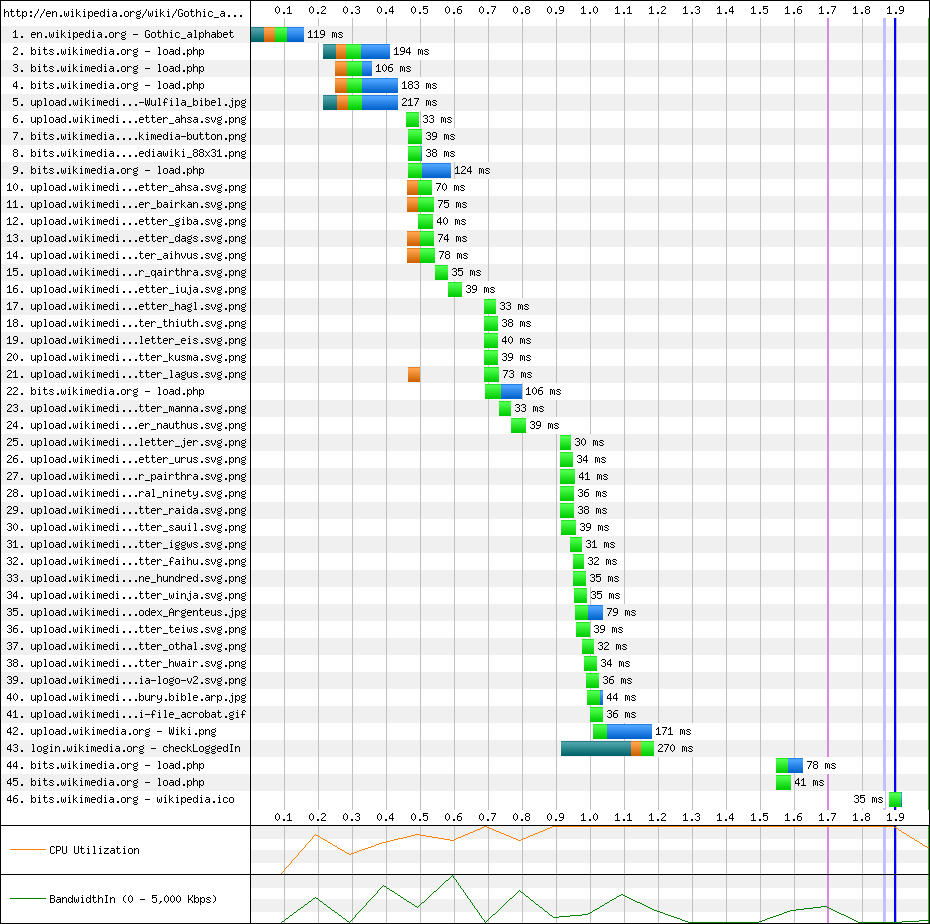
see the effect of this in this image, showing the request waterfall for
[[en:Gothic Alphabet]]: [2]. Notice how no images were requested before the
browser had finished processing the three load.php requests at the top.

To fix this, we want to move the inline scripts above the external CSS. This is
a little bit tricky, because the inline scripts depend on mw.loader, which is
loaded via an external script. If we move the external script so that it too is
above the external stylesheet, we force the browser to serialize requests,
because the browser will not retrieve the external CSS until it has retrieved
and executed the external JS code. So what we want is to move the inline
scripts above the external stylesheet, but keep the external script (which the
inline scripts depend on) below the external stylesheet.

We can do this by wrapping the inline script code in a closure (which binds
'mw') and enqueuing the closure in a global array which will be processed by
the startup module at just the right time.

Net result: external CSS and JS is retrieved in parallel, retrieval of images
(and other external assets) is unblocked, but the order in which code is
evaluated remains the same.

[1]: <http://www.stevesouders.com/blog/2009/05/06/positioning-inline-scripts/>
[2]: <http://people.wikimedia.org/~ori/enwiki-waterfall.png> (excerpted from
 <http://www.webpagetest.org/result/150316_0C_7MB/1/details/>.

Change-Id: I98d383a6299ffbd10210431544a505338ca8643f
Follows-up 9d390a09cd. It already wraps the only=script requests
for 'site' and 'user', but forgot about 'user.groups' which is
not 'scripts' but 'combined' (as regular module requests).

That request responds with mw.loader.implement whih will be absent
if the environment is unsupported.

With normal module requests, this is naturally covered by those
requests not being fired from mw.loader in the first place but
with hardcoded requests like these the condition wrap with
document.write is unfortunately required in the current reality.

Change-Id: Ib3a7378d0c44e601760fbbc5174da09bd7b7f492
Works as intended, but didn't account for the first implement() parameter
being omitted client-side. Revert until that is accounted for, then re-try after
that fix is rolled out for > 1 week.

This reverts commit 4ce0c0da42.

Change-Id: I36c1619991663c0303636d1d3f037b0021ac79bf
Follows-up ebeb297236.

Also:
* Add tests for ResourceLoader::makeLoaderImplementScript().
* Apply ResourceLoader::trimArray to makeLoaderImplementScript (new in c0c221bf).

As always, the client (updated in Ie32e7d6a3c) is backward-compatible with old
(cached) load.php module responses. However, the old client is not compatible
new load.php responses after this commit.

That's generally not an issue, as we don't cache the client very long (~ 5 min).
However people with their browser open and mw.loader clients initialised can
still make new module requests (e.g. modules loaded on-demand, such as when
previewing edits, clicking buttons etc.). That can easily be several hours after
initial page load. As such, client/server bound changes should always be
back-compat and deployed a reasonable time apart to reduce chances of active
sessions making subsequent requests. Ideally we'd find some solution to this in
the long-term, but handling this at all is better than what we usually do...

For deployment: Ensure this is deployed several days after Ie32e7d6a3c09f.

Change-Id: Ic8d7efe49b5d45e3f95a2f04e3a26a014b10af16